
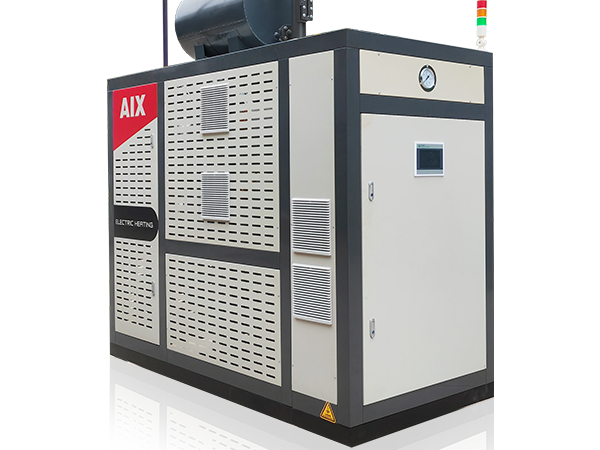
In the wood-based panel industry — encompassing products such as plywood, medium-density fiberboard (MDF), particleboard (chipboard), oriented strand board (OSB), ecological panels, multi-layer boards, and melamine-faced decorative panels — the hot pressing process is the most critical step that determines product quality, bonding strength, surface flatness, internal stress distribution, and formaldehyde emission levels.
Traditionally, many panel factories relied on steam boilers or oil/gas-fired thermal oil systems to supply heat to hot presses. However, with increasingly stringent environmental regulations (especially in China, Southeast Asia, and Europe), rising fuel costs, fluctuating gas prices, and growing demand for precise temperature control and operational safety, electric resistance thermal oil boilers (also known as electric thermal fluid heaters) have become the preferred heating solution for a growing number of modern wood panel production lines.
What Is an Electric Resistance Thermal Oil Boiler?
An electric resistance thermal oil boiler uses immersed or built-in electric heating elements (resistance rods) to directly heat heat transfer oil (thermal fluid/conducting oil). Electricity is converted into heat through the Joule effect, and a circulation pump delivers the high-temperature oil (typically 180–320°C) to the heating platens of the hot press, providing indirect, uniform heating to the panel mat.
Compared to traditional systems:
- No high-pressure steam → no need for water treatment, deaeration, or condensate recovery
- No combustion → zero on-site emissions (CO₂, NOx, SOx, soot), ideal for urban or environmentally sensitive factory locations
- No fuel storage tanks, no exhaust stacks, no burner maintenance
Key Application Scenarios in the Wood Panel Industry
- Hot Pressing (Core Process) The vast majority of wood-based panels require hot pressing at 160–220°C (depending on adhesive type: UF, PF, MDI, pMDI, soy-based, etc.). Uniformity and stability of platen temperature are crucial.
- Plywood & Laminated Veneer Lumber (LVL): Multi-layer veneer + phenolic/urea-formaldehyde glue → needs consistent temperature to avoid delamination, bubbling, or poor bonding.
- MDF / HDF: Fiber + resin → requires platen temperature difference ≤ ±2–3°C across the entire surface to ensure uniform density, bending strength, and surface quality.
- Particleboard / OSB: Wood particles/flakes + adhesive → demands fast heat-up and precise holding temperature to control curing time and prevent over-curing or under-curing.
- Melamine / Decorative / Ecological Panels: Surface paper or veneer lamination → extremely sensitive to temperature fluctuations (even ±5°C can cause resin overflow, color difference, bubbling, or poor gloss).
- Preheating & Drying Assistance Some advanced lines use the same thermal oil loop to supply heat to:
- Veneer dryers
- Fiber dryers
- Pre-press preheating systems
- Mat preconditioning stations This ensures consistent moisture content and temperature before entering the hot press, improving yield and reducing defects.
- Other Auxiliary Heating
- Glue mixing & storage tanks (to maintain viscosity)
- Coating machines / curtain coaters
- Post-press cooling & conditioning (in some integrated systems)
Core Advantages of Electric Resistance Thermal Oil Boilers in Wood Panel Production
| Aspect | Electric Resistance Thermal Oil Boiler Advantage | Comparison with Steam Boiler | Comparison with Oil/Gas Thermal Oil Boiler |
|---|---|---|---|
| Temperature Uniformity | Large oil flow rate, small temperature difference (supply-return ΔT usually 5–10°C), platen surface ΔT ≤ ±2–3°C | Steam condensation is uneven, platen ΔT often 10–20°C | Flame pulsation and burner positioning can cause local overheating |
| Heating Speed | Instant response, full working temperature reached in 30–60 minutes from cold start | Slow startup (1–2+ hours to build pressure and heat) | Fast ignition, but affected by fuel quality and burner stability |
| Temperature Control Precision | PID or PLC intelligent control, accuracy ±1°C, supports multi-stage programmed temperature curves | Steam pressure fluctuations lead to coarse control | Burner modulation has hysteresis, less precise |
| Environmental Compliance | Zero combustion emissions at site, only electricity consumption; easy to meet ultra-low emission standards | Requires desulfurization, denitration, dust removal | Produces NOx, CO₂, soot; faces carbon tax/fuel restrictions |
| Safety & Maintenance | No explosion risk from fuel, no high-pressure vessel concerns, no burner/exhaust cleaning; magnetic anti-scaling effect reduces coking | High-pressure steam risk, frequent water treatment | Fuel leakage/fire risk, burner & chimney maintenance |
| Energy Cost Stability | Electricity price is more predictable than oil/gas; can use off-peak tariffs or renewable power contracts | Fuel price volatility high | Highly dependent on global oil/gas market fluctuations |
| Installation & Footprint | Compact, no chimney/fuel tank required; easy retrofit into existing plants | Needs boiler room, water treatment room, chimney | Requires fuel storage, burner platform, exhaust system |
| Operational Reliability | No flame failure, no fuel blockage; heating elements have long service life (10–15+ years with proper water quality) | Tube scaling/corrosion common | Burner clogging, ignition failure in poor fuel conditions |
Real-World Performance Highlights
Many modern MDF/HDF lines in China, Vietnam, Indonesia, and Russia have reported:
- Energy cost savings of 15–35% after switching from natural gas/oil thermal oil systems (especially in regions with favorable electricity tariffs).
- Defect rate reduction of 20–50% due to better temperature uniformity (fewer edge delaminations, better surface quality).
- Maintenance cost reduction of 60–80% (no burner servicing, no chimney cleaning, minimal descaling).
- Compliance advantage: Zero on-site emissions help factories obtain environmental permits faster and qualify for green subsidies or carbon credits.
Typical Configuration for a Wood Panel Plant
- Capacity: 0.5–3 MW (≈400,000–2,500,000 kcal/h), depending on press size and number of openings.
- Temperature range: 180–260°C (most common 200–240°C).
- Thermal oil: High-quality synthetic or mineral-based oil (e.g., Therminol, Dowtherm equivalents) with low vapor pressure and high thermal stability.
- Control system: PLC + touch screen + remote monitoring (optional IoT integration for predictive maintenance).
- Safety features: Over-temperature protection, low-flow interlock, expansion tank level alarm, explosion-proof junction boxes (if required in dusty environments).
Conclusion
For wood-based panel manufacturers seeking higher product consistency, lower operating costs, reduced environmental impact, and simpler maintenance, electric resistance thermal oil boilers represent one of the most future-proof heating solutions available today. As electricity grids become greener and peak/off-peak pricing more favorable, the economic case for electrification in thermal processes continues to strengthen.
AIX Boiler has supplied numerous electric thermal oil systems to plywood, MDF, particleboard, and decorative panel plants across Asia and beyond. Our units feature high-quality resistance elements, advanced PID control, and robust safety interlocks — delivering reliable, uniform heating year after year.
Interested in upgrading your hot press heating system? Contact the AIX Boiler team for a free consultation, heat load calculation, or customized proposal:
- Email: [email protected]
- Website: https://www.aixboiler.com
- WhatsApp/WeChat: +86 135 9805 9888
- 24/7 Global Support: Ready to assist with site assessment and technical drawings.
Choose clean, precise, and efficient electric heating — choose AIX Boiler for your wood panel production future.