
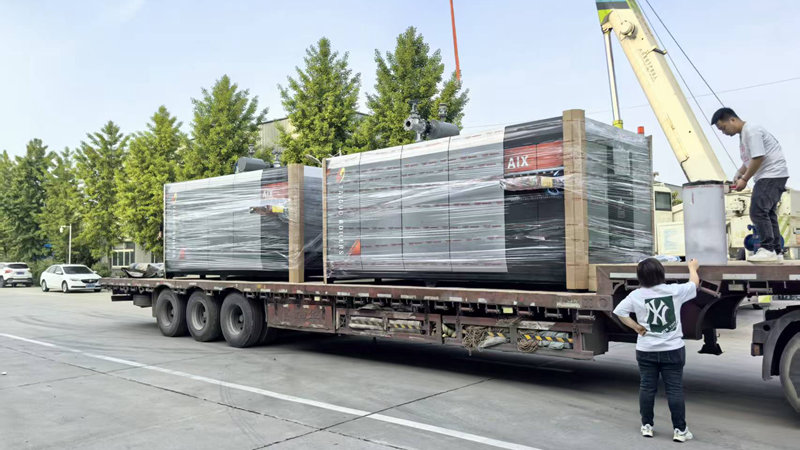
In the industrial boiler market, coal-fired systems remain a reliable choice for steam and hot water generation, especially in regions with abundant coal resources like China, Southeast Asia, and parts of Eastern Europe. For medium-scale applications with steam capacities of 10 to 20 tons per hour (t/h) — common in industries such as textiles, food processing, paper mills, chemicals, and small power plants — selecting the right boiler type is crucial for balancing efficiency, cost, reliability, and environmental compliance.
Two popular options are the SZL double-drum chain grate boiler (a fixed/moving grate design with two steam drums) and the circulating fluidized bed (CFB) boiler (which fluidizes coal particles for combustion). While CFB boilers excel in large-scale or low-quality fuel scenarios, the SZL boiler often proves superior for 10-20 t/h capacities. As a leading A-grade manufacturer with over 45 years of experience, AIX Boiler has delivered numerous SZL units in this range, demonstrating their practical advantages. This article explores why SZL double-drum coal-fired boilers are a better fit than CFB boilers for these mid-range applications.
Understanding the Two Boiler Types
- SZL Double-Drum Boiler: This is a water-tube boiler with a chain grate stoker for coal feeding. The “double-drum” refers to upper and lower steam drums connected by water tubes, ensuring efficient steam separation and circulation. Fuel burns on the grate, with heat transferred via convection and radiation. AIX Boiler‘s SZL series features advanced arch designs, zoned air supply, and optional economizers for optimized performance.
- CFB Boiler: In a CFB system, coal and inert materials (like sand) are fluidized by high-velocity air in the furnace, creating a turbulent bed where combustion occurs. Hot particles recirculate for better burnout. CFBs are known for handling diverse fuels and low emissions but require complex systems like cyclones, separators, and high-pressure fans.
For capacities below 30 t/h (and especially 10-20 t/h), the scale tips toward SZL due to simpler engineering and better economics.
Key Advantages of SZL Over CFB in 10-20 t/h Capacities
1. Lower Initial Investment and Total Ownership Cost
CFB boilers involve sophisticated components — high-speed blowers, particle recirculation systems, and refractory linings — driving up capital costs by 20–50% compared to SZL for similar capacities. In the 10-20 t/h range, where economies of scale don’t fully kick in for CFB, the premium isn’t justified.
SZL boilers, with their straightforward chain grate and drum setup, are more affordable to manufacture and install. AIX Boiler clients report 15–30% savings on upfront costs. Long-term, SZL requires less auxiliary power (no high-energy fluidization fans), reducing electricity bills by 5–10%. Maintenance is simpler too: grate chains and ash removal systems are easier (and cheaper) to service than CFB’s cyclones and refractories, which wear faster under abrasive conditions.
2. Simpler Operation and Higher Reliability
Operating a CFB boiler demands skilled technicians to manage bed temperature (850–950°C), fluidization velocity, and recirculation rates. Bed agglomeration (clinkering) or erosion can cause frequent shutdowns, especially with variable coal quality. In mid-range capacities, these issues amplify due to less forgiving scaling.
SZL boilers are more “forgiving” and user-friendly: Automated chain grates handle coal feeding/ash discharge with minimal intervention. Startup is quicker (30–60 minutes vs. 1–2 hours for CFB), and load response is stable for fluctuating demands in textiles or food plants. AIX Boiler‘s SZL models include intelligent PLC controls for easy monitoring, achieving 98–99% availability in real-world operations — often 5–10% higher than CFB in this size range.
3. Comparable Efficiency with Better Adaptability to Standard Fuels
Both types can reach 82–88% thermal efficiency, but SZL shines with good-quality coal (common in 10-20 t/h setups). Its layered combustion on the grate ensures complete burnout without needing fluidization. Add-ons like air pre-heaters (standard in AIX Boiler SZL) boost efficiency to 85–90%.
CFB excels with low-calorific or high-ash fuels (e.g., lignite, biomass co-firing), but for standard bituminous/anthracite coal, the complexity is overkill. In smaller capacities, CFB’s higher auxiliary power consumption (up to 10–15% of output) can erode net efficiency gains. SZL, with lower parasitic loads, often nets higher overall plant efficiency.
4. Easier Environmental Compliance and Lower Emissions in Mid-Scale
Environmental regs are tightening, but SZL boilers can meet them cost-effectively at 10-20 t/h. With low-NOx staged combustion, bag filters, and desulfurization (e.g., wet scrubbers), SZL achieves NOx <200 mg/Nm³ and particulates <30 mg/Nm³ — sufficient for many regions.
CFB inherently offers better in-furnace desulfurization (via limestone injection) and lower NOx, but the full setup (including sorbent handling) adds complexity and cost. For mid-range plants without ultra-low emission mandates, SZL with retrofittable controls is more practical. AIX Boiler integrates eco-features like economizers and low-emission grates, helping clients comply without CFB’s overhead.
5. Compact Footprint and Easier Integration
SZL boilers are more compact for 10-20 t/h, with a simpler layout fitting into existing boiler rooms. The double-drum design allows modular assembly, ideal for retrofits.
CFB requires taller furnaces (for circulation) and more space for auxiliaries, making it less suitable for space-constrained sites. AIX Boiler‘s SZL units often save 20–30% in footprint, easing installation in factories or small cogeneration plants.
Real-World Case Studies from AIX Boiler
- Textile Mill in Bangladesh (15 t/h SZL): Replaced a CFB unit plagued by bed issues. SZL reduced downtime by 40%, cut maintenance costs 25%, and maintained 85% efficiency with local coal.
- Paper Plant in Indonesia (12 t/h SZL): Chose SZL over CFB for simpler operation; achieved NOx <150 mg/Nm³ with basic controls, saving $100K in initial costs.
- Food Processing in China (18 t/h SZL): Variable loads handled smoothly; efficiency matched CFB but with 20% lower power use.
These examples highlight SZL’s edge in practical, mid-scale scenarios.
When CFB Might Still Be Better (And When It’s Not)
CFB shines for >30 t/h capacities, very poor fuels, or ultra-low emissions (e.g., SOx <35 mg/Nm³). But for 10-20 t/h with standard coal, SZL’s simplicity, cost, and reliability win out. Over-engineering with CFB often leads to higher OPEX without proportional benefits.
Conclusion: Choose SZL for Smart, Mid-Range Coal-Fired Performance
For 10-20 t/h coal-fired boilers, the SZL double-drum design offers a compelling mix of affordability, ease of use, reliability, and efficiency — outperforming CFB in most real-world applications. As global energy transitions evolve, SZL provides a bridge to sustainable heating without unnecessary complexity.
At AIX Boiler, our SZL series is engineered for durability, with A-grade certification, ISO/CE compliance, and proven performance in 80+ countries. If you’re evaluating boilers in this range, consider SZL for long-term value.
Ready to optimize your operations? Contact the AIX Boiler team today:
- Email: [email protected]
- Website: https://www.aixboiler.com
- WhatsApp/WeChat: +86 130 376 00603
- Global 24/7 Support: We’re here for consultations, fuel analysis, and custom designs.
Switch to SZL with AIX Boiler — reliable, efficient, and cost-effective coal-fired heating.